
Fire Safety Compliance Tools for Property Managers in 2026
Managing fire safety across a property portfolio means coordinating information, people, contractors and systems across multiple buildings.
9 min read
Admin 18 Sep 2026
Managing a fire maintenance business involves both commercial coordination and specialist technical work. Scheduling, engineer allocation, client communication, testing, reporting and invoicing all need to move efficiently, but they are not necessarily best served by the same type of technology. When considering how Uptick and Nimbus fit together, it is helpful to begin with the role each platform was designed to perform.
The short answer: Uptick is a purpose-built fire inspection and field service management platform that handles the business workflow from initial quote through to invoicing. Nimbus provides specialist fire alarm testing hardware and cloud software that supports what happens on site and after the visit — panel-level test capture, real-time monitoring and compliance evidence.
They are not direct substitutes. For fire maintenance businesses looking to improve both their operational workflows and their on-site service delivery, the two platforms can complement one another by supporting different stages of the same service workflow.
The most useful starting point is purpose. Both Uptick and Nimbus contribute to a more efficient, more compliant service operation — but they are designed to address different requirements within the same workflow.
Uptick helps businesses plan, schedule, administer and manage work from end to end. Nimbus is focused on how fire alarm servicing, testing and commissioning activities are carried out on site, and how that information is captured, evidenced and shared with clients.
Uptick is a fire protection software platform built specifically for inspection, testing and maintenance businesses. Having established itself across Australia and New Zealand, it has now entered the UK market with British Standards built in, including BS 5839 and BS 7273.
Its core capabilities cover the full commercial and operational lifecycle of a service visit:
For operations managers and scheduling teams, Uptick removes a significant amount of administrative friction. Many businesses report saving up to an hour a day in manual tasks after adopting the platform.
nimbusGo combines a portable device with cloud software to support fire alarm servicing, testing and commissioning. The device connects directly to compatible fire alarm control panels, reads live panel events, and captures testing information as engineers work through the building.
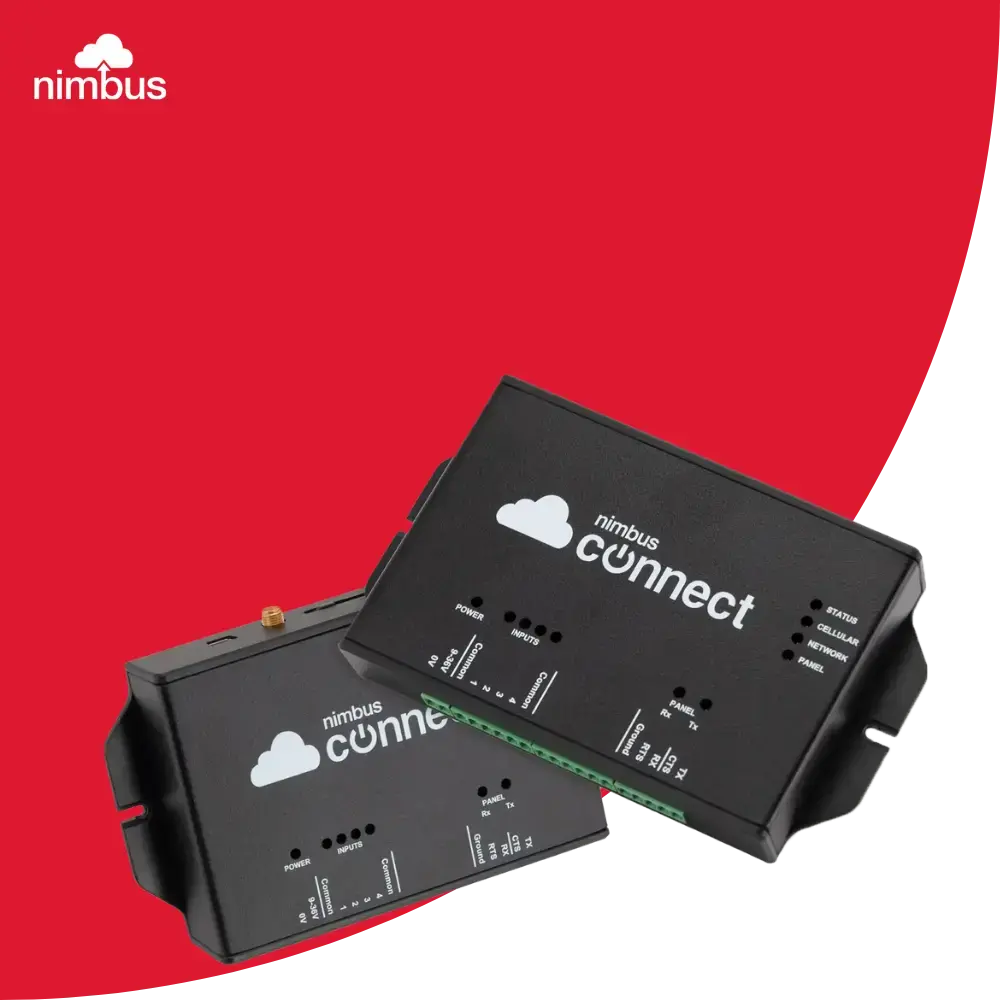
Nimbus Connect extends that capability to the client side, providing real-time fire system monitoring, instant event notifications and a permanent, auditable cloud record of every alarm, fault and weekly test across a property portfolio.
Together, the Nimbus platform addresses the part of the fire safety workflow that sits beyond the scope of a field service management tool:
The value of using Uptick and Nimbus together becomes clearer when you map them against the stages of a typical fire maintenance visit. Each platform contributes at different points, and those contributions do not overlap.
|
Workflow Stage |
Uptick |
Nimbus (nimbusGo) |
|
Job scheduling and dispatch |
Smart scheduling, geographic allocation, recurring inspections |
Not applicable |
|
Quoting and invoicing |
Full quote-to-invoice workflow, online client approval |
Automated remedial reports with part numbers and photos |
|
On-site testing (panel interaction) |
Digital inspection forms and checklists |
Direct panel connection, auto-logged pass/fail per device |
|
Zone verification (BS 5839 Clause 43) |
Manual process, engineer records manually |
One-engineer capable; panel-driven verification |
|
Compliance evidence |
Digital job records and certificates |
Non-editable, panel-derived records; BS 5839 Clause 43.3.25 |
|
Asset register |
Site and equipment records |
Instant asset creation from panel configuration files |
|
Client reporting |
Report generation from job data |
Automated end-of-visit reports with timestamps and photos |
|
Ongoing monitoring (between visits) |
Not applicable |
Real-time alerts via Nimbus Connect; 24/7 portfolio visibility |
Uptick's strength is in the commercial and operational layer. Scheduling visits efficiently, ensuring the right engineer is allocated to the right job, turning completed work into quotes and invoices quickly — these are the activities that determine whether a fire maintenance business is profitable and scalable.
The platform's built-in British Standards and digital inspection forms also mean engineers arrive on site with the right templates and leave with a professional, consistent record of the work completed. That matters both for the client relationship and for the contractor's own quality management.
Nimbus addresses what happens during and after the technical work itself. When an engineer connects nimbusGo to a compatible fire alarm panel, the system reads live panel events in real time. As devices are tested, results are captured automatically — not typed in after the fact, not reconstructed from memory, but logged at the point of test from the panel itself.
That distinction carries real weight in a compliance context. A record that can be retrospectively edited is not the same as a record that cannot. For contractors working in healthcare, education, housing or any sector where audit scrutiny is high, non-editable panel-derived evidence is a meaningful differentiator. It matters to both the contractor and the client.
Nimbus Connect then extends that value beyond the visit. Clients gain a live view of their fire systems, with instant notifications for alarms, faults and isolations. Building managers do not need to wait for a quarterly report to understand the state of their systems. They can see it in real time, from any device.
"nimbusGo brings total transparency to fire system testing. It's a smart, scalable solution that gives us the compliance assurance our clients demand and our engineers trust." — Marlowe Fire and Security Group
Compliance in fire alarm servicing is not just about completing the work — it is about being able to prove it, clearly and without ambiguity, at any point in the future.
Uptick supports this through its digital inspection forms, defect tracking and client portal. Engineers complete structured records on site, and clients have access to those records without needing to request them. That transparency builds trust and reduces the administrative burden on both sides.
Nimbus takes compliance evidence a step further by capturing it directly from the fire alarm panel. There is a meaningful difference between a record that an engineer has filled in and a record that the panel itself has produced. The former depends on accuracy and discipline. The latter is automatic, timestamped and cannot be altered.
BS 5839 Part 1 sets out the requirements for the design, installation, commissioning and maintenance of fire detection and alarm systems in non-domestic premises. Clause 43 specifically governs the servicing and testing process, including requirements for zone verification and the standard of records that should be maintained.
nimbusGo is designed to meet the requirements of Clause 43.3.25, which relates to the verification of fire alarm systems during servicing. The combination of panel-driven test capture, device-level logging and non-editable records means the evidence produced during a nimbusGo-supported visit is aligned with what the standard requires.
Uptick's built-in British Standards support ensures that the inspection forms and workflows engineers use on site reflect current regulatory expectations. The two approaches are complementary: Uptick structures the visit, Nimbus evidences it.
For contractors managing a large number of sites, audit readiness is not just a compliance issue — it is a commercial one. Clients in regulated sectors increasingly expect their fire maintenance contractor to provide accessible, verifiable records as a matter of course. Contractors who can demonstrate that level of transparency are better placed to retain clients and win new ones.
Nimbus Connect gives building managers a permanent, searchable record of every event, test and service visit across their portfolio. When an insurer, regulator or internal auditor asks for evidence, the information is there — structured, timestamped and ready.
For operations managers evaluating the combined investment: the compliance benefits are worth considering alongside the operational ones. Contractors working in regulated sectors are increasingly expected to provide accessible, verifiable records as a matter of course, and the cost of incomplete documentation can extend well beyond the platforms themselves.
Labour efficiency is one of the most direct measures of whether a technology investment is working. Time spent on administration, manual data entry, repeated panel trips and post-visit report writing is time that cannot be billed. Reducing it has a direct impact on margin.
Uptick and Nimbus each address different parts of that efficiency equation.
Uptick's scheduling tools eliminate the manual effort involved in planning visits. Geographic allocation ensures engineers are not travelling unnecessarily between distant sites. Recurring inspection schedules are set once and maintained automatically. Defect quotes are generated from the field, with clients approving online — removing the back-and-forth that typically delays remedial work.
For office-based teams, the reduction in duplicate data entry and manual coordination can be significant. Scheduling, job records, customer communication, invoicing and performance reporting all sit within one system, reducing the time spent moving information between disconnected tools.
nimbusGo focuses on the time spent during the visit itself. By connecting to a compatible fire alarm panel, the device gives an engineer access to live panel activity while they move around the building. Testing information is captured as devices are operated. That removes the need to record results manually or make repeated journeys back to the control panel.
The practical benefits are well documented:
For a contractor running multiple large-site visits each month, the cumulative benefit can be significant. Whether a one-engineer approach is appropriate will depend on the site, system, scope of work and relevant safety arrangements, so the labour benefit will vary. For suitable sites and workflows, reducing repeated panel checks or additional engineer involvement can make servicing more efficient without reducing the quality of the information captured.
"Nimbus gives us great traceability and evidence for all our servicing contracts — it's a huge benefit to us." — M&G Fire Protection
Read how M&G Fire Protection reduced labour costs and improved zone plan verification after adopting nimbusGo.
Consider a fire maintenance contractor managing a portfolio of commercial and mixed-use sites. Their typical workflow involves scheduling visits, allocating engineers, carrying out testing and servicing, raising remedial quotes, and providing clients with service records.
With Uptick handling the operational layer, the scheduling team works from a single platform. Jobs are planned efficiently, engineers receive their day's work on a mobile app, and completed visits flow through to invoicing without manual intervention. Clients can track maintenance activity through the Uptick portal and approve quotes with a single click.
With nimbusGo on site, the engineer connects to the fire alarm panel on arrival. As they work through the building, the system logs each device test in real time. There is no paper record to complete, no panel trip required to verify a zone, and no report to write up at the end of the visit. The automated end-of-visit report, complete with device-level results, timestamps and any identified defects with photos and part numbers, is ready before the engineer leaves the site.
Clients with Nimbus Connect installed benefit further. Between visits, they receive instant notifications for any alarm, fault or isolation event. Their building manager has a live view of the fire system at all times, and the full service history is accessible whenever they need it.
The gap that neither platform closes on its own is the one between operational efficiency and specialist technical compliance. Uptick manages the business workflow. Nimbus captures the technical evidence. Together, they provide fire maintenance contractors with a more complete picture — and give their clients a more complete service.
Understanding that distinction makes it easier to assess where each platform fits within the business and what value it would need to deliver.
For contractors who have already adopted one platform, adding the other is a natural next step. They are not competing for the same part of the workflow. They are filling in the parts the other leaves open.
For fire maintenance contractors considering either platform, the starting point is understanding which part of the operation needs the most attention.
If the priority is improving scheduling, job management, client communication and commercial workflows, Uptick is the more relevant starting point. If the priority is raising the quality of on-site testing, reducing labour time and providing clients with unequivocal compliance evidence, nimbusGo is where to begin.
For some contractors, this will not be an either-or decision. Both platforms are cloud-based and designed to work alongside existing ways of working rather than replace them entirely.
To explore how nimbusGo or Nimbus Connect could support your service operation, speak with the Nimbus team or book a demo to see the platform in action.
You may also find it useful to read our comparison of nimbusGo and Clik Software, which explores a similar question for contractors already using a field service management platform.

Managing fire safety across a property portfolio means coordinating information, people, contractors and systems across multiple buildings.

Every facility or property manager recognises their core responsibility to keep people and property safe.

For Building Owners and Managers Introduction: In light of heightened safety concerns and the potential severe consequences of non-compliance, ...